Stackable washer and dryer repair in Farmington, NM
A stacked laundry pair in a narrow closet is hard to service, so small faults get ignored until one half quits. We repair one-piece laundry centers and stacked front-load pairs, working inside tight spaces without damaging your walls or floor.
- Answered 24/7
- Gas, electric and propane
- Farmington and the Four Corners
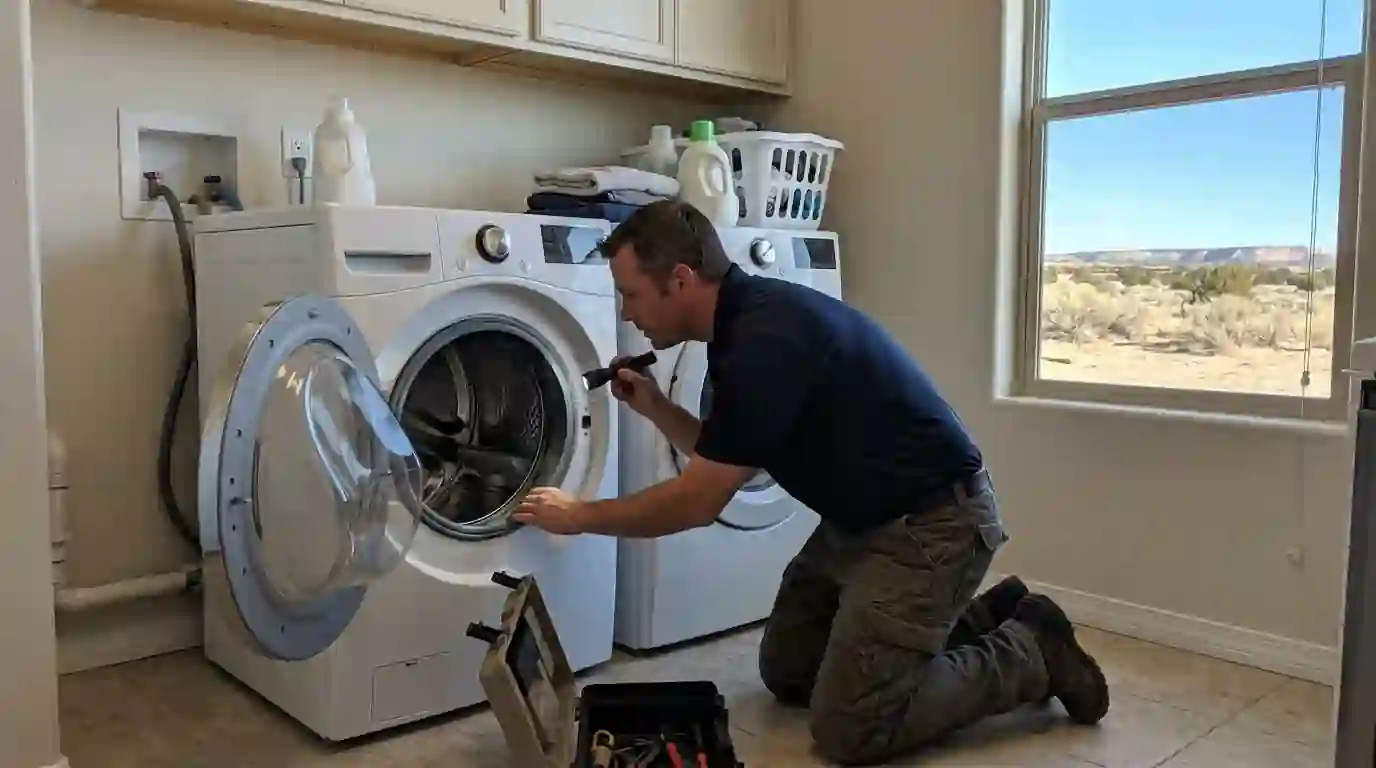
Stacked laundry problems
- Top dryer runs but stays cold
- Bottom washer leaves water in the tub
- Whole unit walks during the spin
Quick answer
Stacked laundry units around Farmington usually fail at the washer drain pump, the lid or door switch, the dryer heating element or igniter, drum rollers, or the shared control. Typical repairs here run about $136-$389, depending on the model and which half failed. Many jobs are done in one visit without unstacking, and our phones are answered 24/7.
Brands we repair: Whirlpool, GE, Samsung, LG, Maytag, Frigidaire, KitchenAid, Bosch, Kenmore, Electrolux, Amana, Speed Queen, Sub-Zero, Hotpoint
Two kinds of stacked laundry, and why each fails differently
Stacked laundry comes in two forms. A laundry center is one cabinet: a small top-load washer at the bottom, a dryer above it, and often a single set of controls up top. A stacked pair is two separate front-load machines, a washer on the floor and a matching dryer bolted above it with a stacking kit. The parts inside are close to full-size machines, but the space around them is not. That changes how we diagnose and repair them.
On a laundry center, one bad control or a single power cord can take down both halves, and the washer's lid switch, drive belt and transmission share a cramped lower cabinet. Many electric laundry centers run off a 240-volt cord, and the gas versions add a burner beside the drum. On a stacked pair, each machine has its own cord and controls, but the dryer sits at shoulder height and the washer's rear panel is buried against the wall.
Our techs carry a low-profile dolly, appliance slides and a sturdy step stool for these jobs. Many repairs, including a dryer belt, a washer drain pump or a door switch, can be done through the front or the top without separating the units. When the dryer has to come down, two people lift it off the stacking kit, and we pad the washer top and nearby trim first.
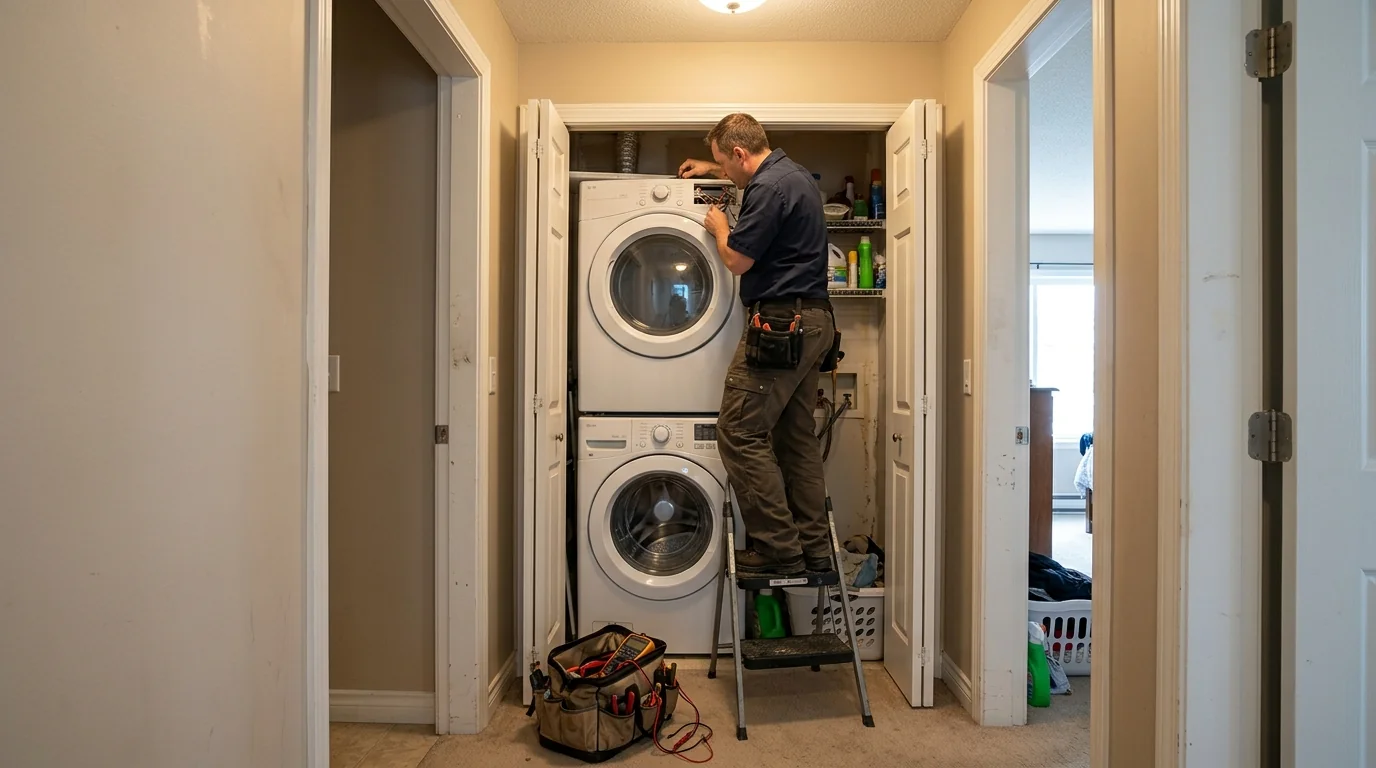
Stacked laundry repairs our techs handle
These six repairs cover most of the stacked units we see.
Drain pump and filter
We clear the coin trap or pump filter, replace a seized or noisy drain pump and reseat the drain hose so the washer empties fully and the spin cycle can start.
Lid lock and door switch
A failed lid lock on a laundry center or door lock on a front-load washer stops the cycle cold. We test the switch, wiring and latch, then replace the faulty part.
Dryer heating element or igniter
Electric stacked dryers get a new element and thermal fuse. Gas versions get an igniter, flame sensor or valve coils, plus a check that the burner matches your fuel type.
Drum rollers, belt and idler
We replace worn rollers, the idler pulley and the belt from the front of the dryer, which often avoids lifting it off the washer entirely.
Shocks, springs and stacking kit
Stacked front-loaders get new shock absorbers or springs when they rock. We tighten or replace the stacking kit hardware and level the feet so the tower stays put.
Inlet valve and control
Slow fills and water errors get new inlet screens or a valve. When a shared laundry center control fails, we confirm with tests before ordering it, since boards cost more.
Stacked washer and dryer symptoms we hear most
Tell us which half is acting up and what it does, and we can usually guess the part.
Top dryer tumbles without heat
On electric models, a blown thermal fuse or an open heating element is most likely. On gas models, igniters and valve coils fail. A clogged vent stuffed behind a closet wall is often the underlying reason.
Washer will not drain
Water left in the tub means a clogged drain pump filter, a sock in the pump or a failed pump motor. Laundry centers also tuck a drain hose that kinks when the unit is pushed back.
Washer fills but never agitates
On a laundry center, a broken lid switch, a worn drive belt or a failed motor coupling stops agitation. The washer may hum, click or simply drain and stop without washing.
Shaking and walking on spin
Worn shock absorbers or suspension springs, a missing stacking kit bracket or unlevel feet let the whole tower rock. On a raised closet floor, it can knock against the walls or door.
Squeal or thump from above
Dryer drum rollers, the idler pulley and the front glides wear out and get noisier each week. A thump with every rotation usually means a flat spot on a roller or a damaged belt.
Both halves dead at once
On a laundry center, a single cord, plug, door switch or main control can shut down washer and dryer together. We check the outlet and breaker first, then the shared control.
What stackable laundry repairs typically cost here
These ranges show what similar repairs usually cost around Farmington, parts and labor together. They are not a quote for your unit.
| Washer drain pump | $164-$298 |
|---|---|
| Lid lock or door switch | $136-$247 |
| Dryer element or gas igniter | $148-$276 |
| Shocks, springs or stacking kit | $171-$329 |
| Laundry center control board | $218-$389 |
Separating a stacked pair, a hard-to-reach closet and a control board on back order all raise the cost. We tell you the price before we start the repair.
Closets, mobile homes and apartments around San Juan County
Stacked laundry turns up wherever space is tight: hallway closets in apartments near San Juan College, duplexes in older parts of town, and the utility closets of manufactured homes across the county. Manufactured home closets are often narrow, with a light floor deck and a vent run that goes through the side wall or the belly of the home. We check that the floor under a stacked unit is solid and level, because a spongy floor makes a washer spin loose and loosens the stacking kit.
Hard, mineral-heavy water is common around Farmington, especially on private wells. It clogs the screens in a washer's inlet valve and leaves scale in the tub and pump, so a stacked washer that fills slowly or shows a water-supply error code often just needs clean inlet screens or a new valve. Fine dust from windy spring days collects in the dryer half's lint path, and in a tight closet that dust has nowhere to go but back into the cabinet.
Closet dryers in older homes often vent through long ducts with several turns, and a flexible foil duct crushed behind the tower is something we find often. Before we finish any dryer repair, we look at the duct behind the unit and the cap outside, because poor airflow is what keeps cooking thermal fuses in stacked dryers.
How we work on a stacked unit in a small space
- On the phone
Which half and which kind
We ask whether it is a one-piece laundry center or two machines, which half is failing and the model numbers so we can bring likely parts.
- At the closet
Protect the space
We lay down floor pads, check the outlet, water valves and vent connection, and look at how much room we have to work around the unit.
- Minute 15
Test without unstacking
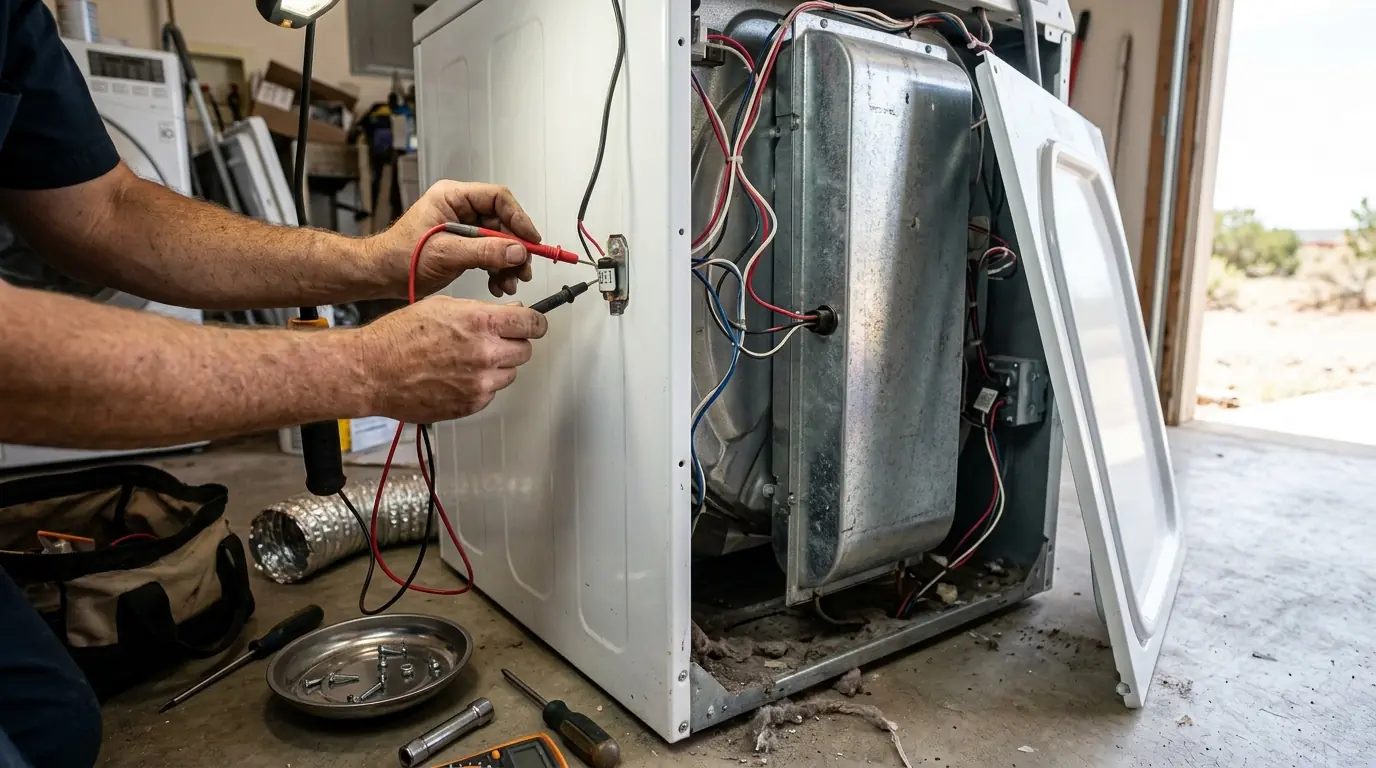
Our tech runs diagnostic modes and meter tests through the front and top panels first, so the dryer comes down only when the repair truly requires it.
- Same visit
Repair and run both halves
After the fix, we run a short wash and drain, then a heated dry cycle, so we know both halves work together before we put panels back.
- Before we leave
Level and secure
We level the tower, tighten the stacking kit and check the vent and hoses so the unit can slide back into place without kinks.
Repair one half, or replace the whole tower?
With a stacked pair, one machine can be replaced while the other stays, as long as the new one fits the same stacking kit. With a one-piece laundry center, a dead washer means replacing both halves together, so repairs tend to make sense longer. We usually recommend fixing a laundry center unless the washer tub is cracked, the transmission has failed or the shared control is no longer available.
Because a tower is fiddly to remove from a small closet, the labor of replacing it can be higher than you'd expect. We'll give you a straight read on which parts are failing, how worn the rest of the tower looks, and how long it is likely to hold before the next repair.
Keeping a stacked laundry tower running longer
- Leave a few inches behind the tower so the dryer duct and washer hoses are never crushed when the unit is pushed back into its closet.
- Use half loads in a compact laundry center washer. Overstuffing a small tub strains the belt, the motor coupling and the suspension.
- Leave the closet door open or louvered while the dryer runs. Trapped heat makes the machine dry slower and work harder.
- Clean the washer's pump filter every few months if your model has one. A coin or hairpin there can stop draining completely.
- Replace rubber inlet hoses with braided ones. A burst hose inside a closet can flood a hallway before anyone notices.
Related repairs people book with stackable washer & dryer repair
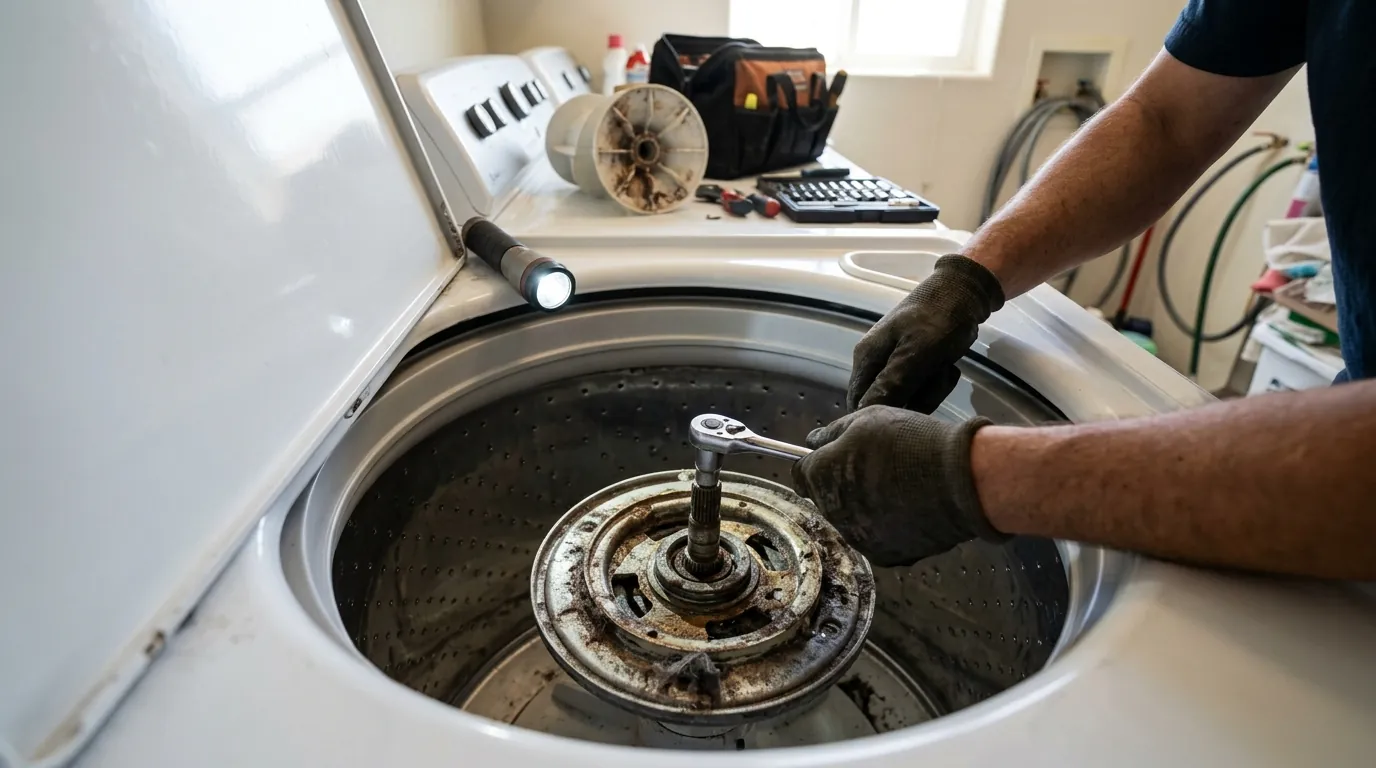
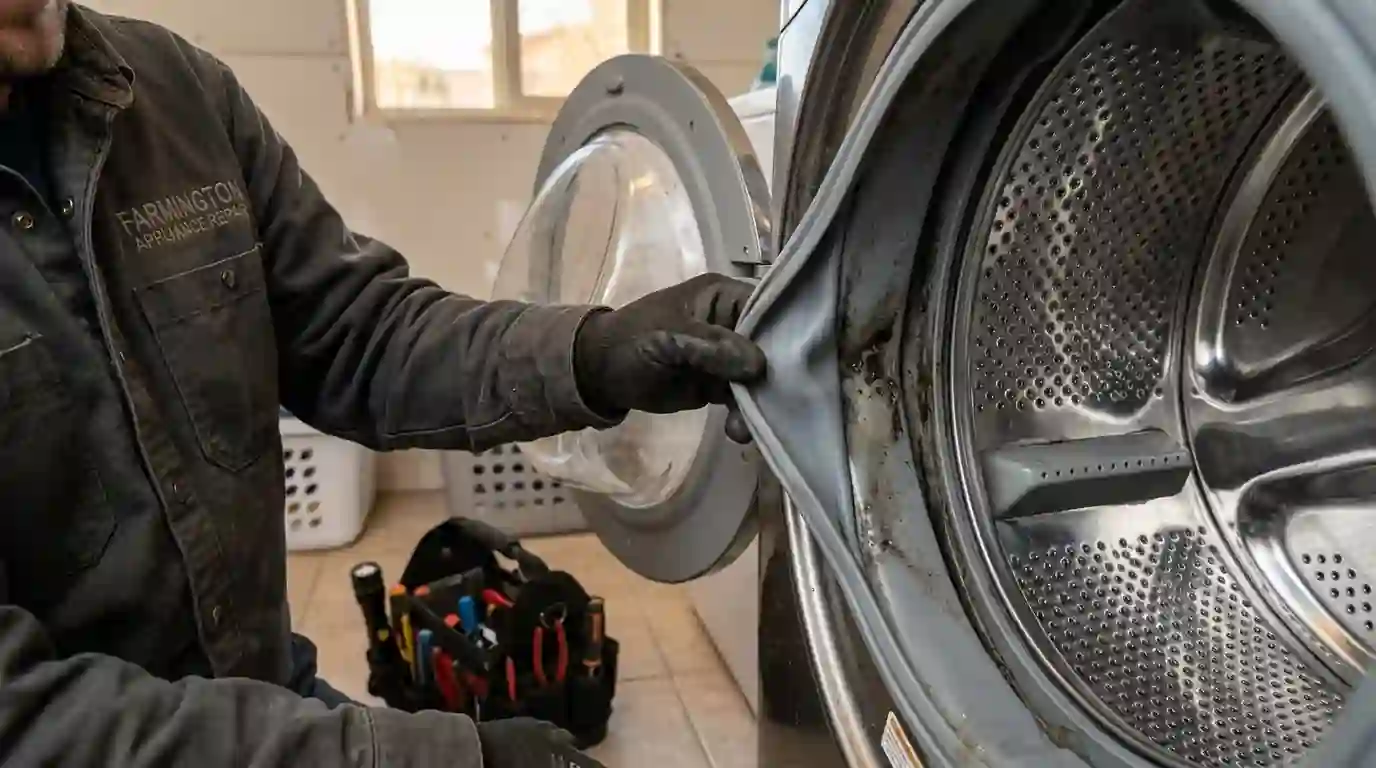
Where we handle stackable washer & dryer repair
Farmington neighborhoods first, then the rest of San Juan County and southwest Colorado. Pick your area for local notes, or see all 41 locations.
Stackable Washer & Dryer Repair questions from Farmington homeowners
Can you repair a stackable washer and dryer without taking them apart?
Often, yes. Drain pumps, lid switches, door locks, dryer belts, rollers, igniters and heating elements can usually be reached through the front or top panels. We separate the units only when a repair requires access to the back of the washer or the base of the dryer, and we bring a second person when that happens.
Why does my stacked dryer take so long to dry clothes in a closet?
Tight closets cause two problems: the vent duct gets crushed behind the unit, and heat builds up around the cabinet. Both slow drying and wear out the thermal fuse. Check that the duct is not flattened and that the outside cap opens when the dryer runs. If drying is still slow, the heating element or igniter may be weak.
Is a one-piece laundry center worth repairing when the washer stops?
Usually it is, because replacing a laundry center means buying both washer and dryer together. Lid switches, drive belts, motor couplings and drain pumps are reasonably priced repairs. A cracked outer tub or a failed transmission on an older unit is the point where replacing the whole laundry center starts to make more sense.
Why does my stackable washer shake the whole closet during spin?
A stacked washer that rocks usually has worn shock absorbers or springs, unlevel feet, or a load that bunched to one side. It can also mean the stacking kit has loosened. If the floor flexes underfoot, as some manufactured home floors do, the shaking gets worse. We replace worn parts, level the unit and tighten the kit.
Do you work on stacked washer and dryer units in mobile homes?
Yes. Manufactured homes around San Juan County often have stacked or side-by-side laundry in a narrow closet. We check the floor deck, the vent route and the water connections, since dryer exhaust in these homes sometimes exits under the floor or out a side panel. Measure the closet and send the model number when you call so we bring the right parts.
Can a gas stackable dryer run on propane?
Many gas laundry centers and stacked gas dryers accept an LP conversion kit, which swaps the burner orifice and sets the valve for propane. A unit moved from a city-gas house to one fed by an LP tank should get that kit fitted before its first load. We check the model's conversion options when we inspect the burner.
Need stackable washer & dryer repair today?
Call any hour. A real person picks up, takes the model number and sets the visit.